463 KM Without Coach Brakes: The Real Engineering Reason Behind the Empty Vande Bharat Express Incident and How Loco Pilots Prevented a Derailment
An empty Vande Bharat Express chair car rake travelled nearly 463 kilometres from Hatia in Jharkhand to Pandit Deen Dayal Upadhyaya Junction in Uttar Pradesh on October 24, 2026, without active coach brakes while being hauled dead by a freight electric locomotive. Despite two different loco pilots flagging poor braking performance at Ranchi and Muri stations, the train was allowed to continue its journey until an inspection at DDU Junction revealed that the brake isolation cocks on every coach had been left closed. This technical analysis explains how Vande Bharat's backup pneumatic air brake system works during locomotive towing, why dropping Brake Pipe pressure failed to engage the axle disc brakes.
What Actually Happened on October 24 Between Hatia and DDU Junction?
On October 24, 2026, operating instructions were issued in the Ranchi Division of South Eastern Railway to move an empty Vande Bharat Express chair car rake from Hatia in Jharkhand to Jhansi in Uttar Pradesh. Because this was an empty transfer movement, the trainset was not running on its own overhead electric power. Instead, its front aerodynamic nose cone was opened, and the unpowered rake was coupled to a freight electric locomotive for dead hauling.
According to Indian Railways operating rules, shortly after departing from Hatia station, the first loco pilot performed the mandatory Brake Feel and Brake Power Test in the Hatia–Ranchi section. During this test, the loco pilot immediately noticed that the train was not slowing down properly and that the braking power was extremely weak. Upon reaching Ranchi station, the loco pilot submitted a formal written complaint to the Section Controller and the Traction Loco Controller regarding the poor brake power. However, instead of halting the rake for a mechanical inspection, officials cleared the train to proceed in the same condition.
When the train reached Muri Junction and a second loco pilot took charge of the locomotive, he too noticed the exact same problem. He alerted the control room that even after dropping the Brake Pipe air pressure, the brakes in the trailing Vande Bharat coaches were not engaging at all. Even after this second warning, the train was not stopped en route. The empty rake finally halted for a detailed check at Pandit Deen Dayal Upadhyaya Junction in Uttar Pradesh's Chandauli district after covering nearly 463 kilometres. When Carriage and Wagon staff inspected the underframe of the coaches at DDU Junction, they found that the braking systems of all coaches had been isolated, meaning not a single coach brake had worked during the entire 463-kilometre run.
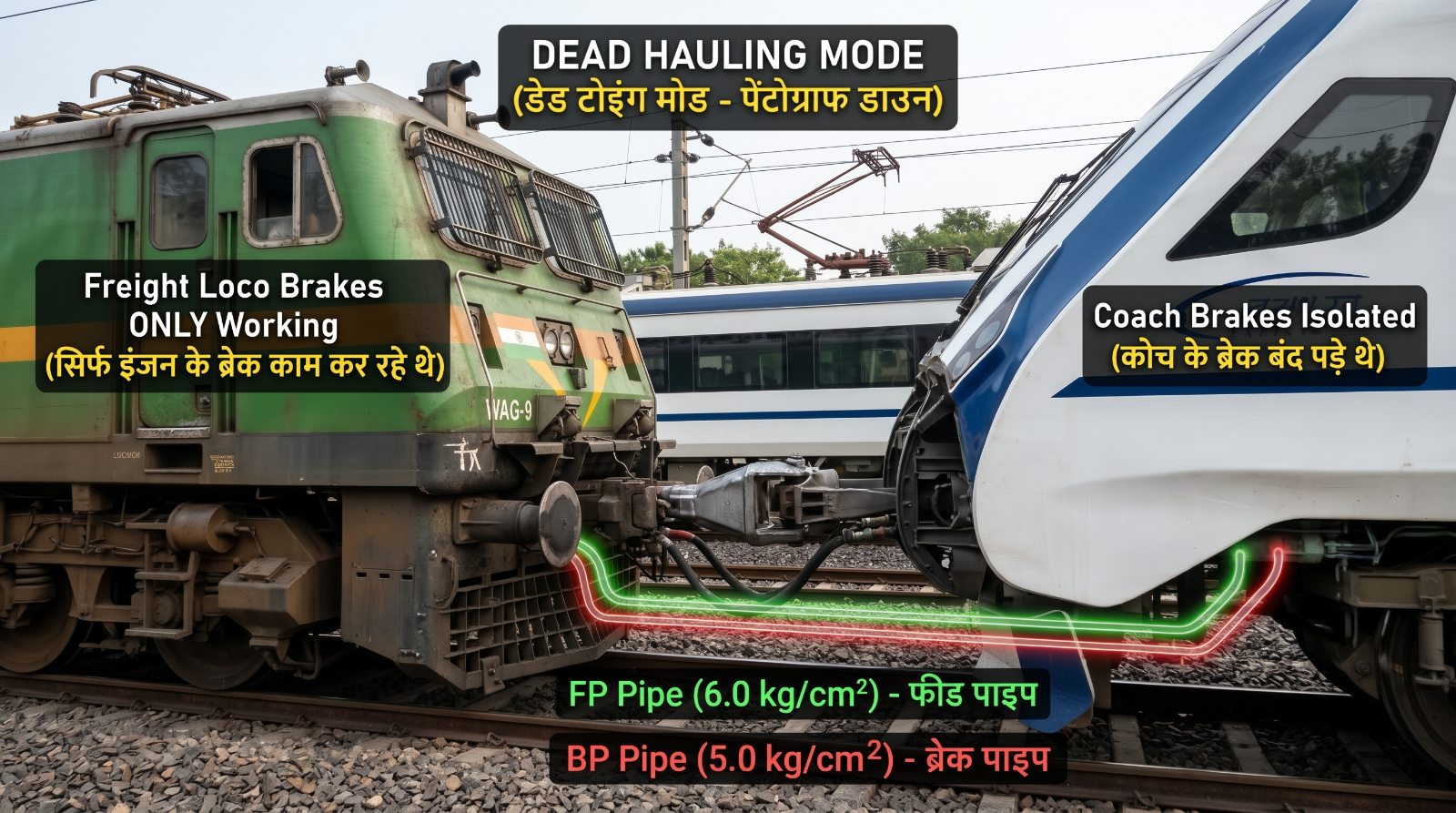
Normal EP Brakes vs Dead Hauling Mode: The Engineering Difference
To understand how all coach brakes remained off without triggering an automatic computer shutdown, we need to look at how the Vande Bharat Express braking architecture operates in two completely different modes.
During normal passenger service, Vande Bharat runs with its pantograph raised and its Train Control and Management System active. In this mode, the train uses an Electro-Pneumatic brake system blended with regenerative braking. The moment the loco pilot moves the brake handle, an electronic signal travels instantly to the Brake Control Unit in every coach, applying the axle-mounted disc brakes within milliseconds.
However, during dead hauling behind a freight locomotive like a WAG-9, the Vande Bharat rake is completely powered down. Its pantograph is lowered, the Vacuum Circuit Breaker is open, and its onboard computer network is switched off. Since a freight locomotive uses a standard Central Buffer Coupler and Vande Bharat uses an automatic Scharfenberg coupler, the two are joined using a heavy steel Transition Coupler. Because there is no electrical data cable connecting the freight locomotive to Vande Bharat's computers, the trainset must operate purely on pneumatic air pressure, just like a conventional coach. For this, two air hoses from the locomotive are connected to the Vande Bharat rake: the Feed Pipe carrying 6.0 kg/cm² of air pressure and the Brake Pipe carrying 5.0 kg/cm² of air pressure.
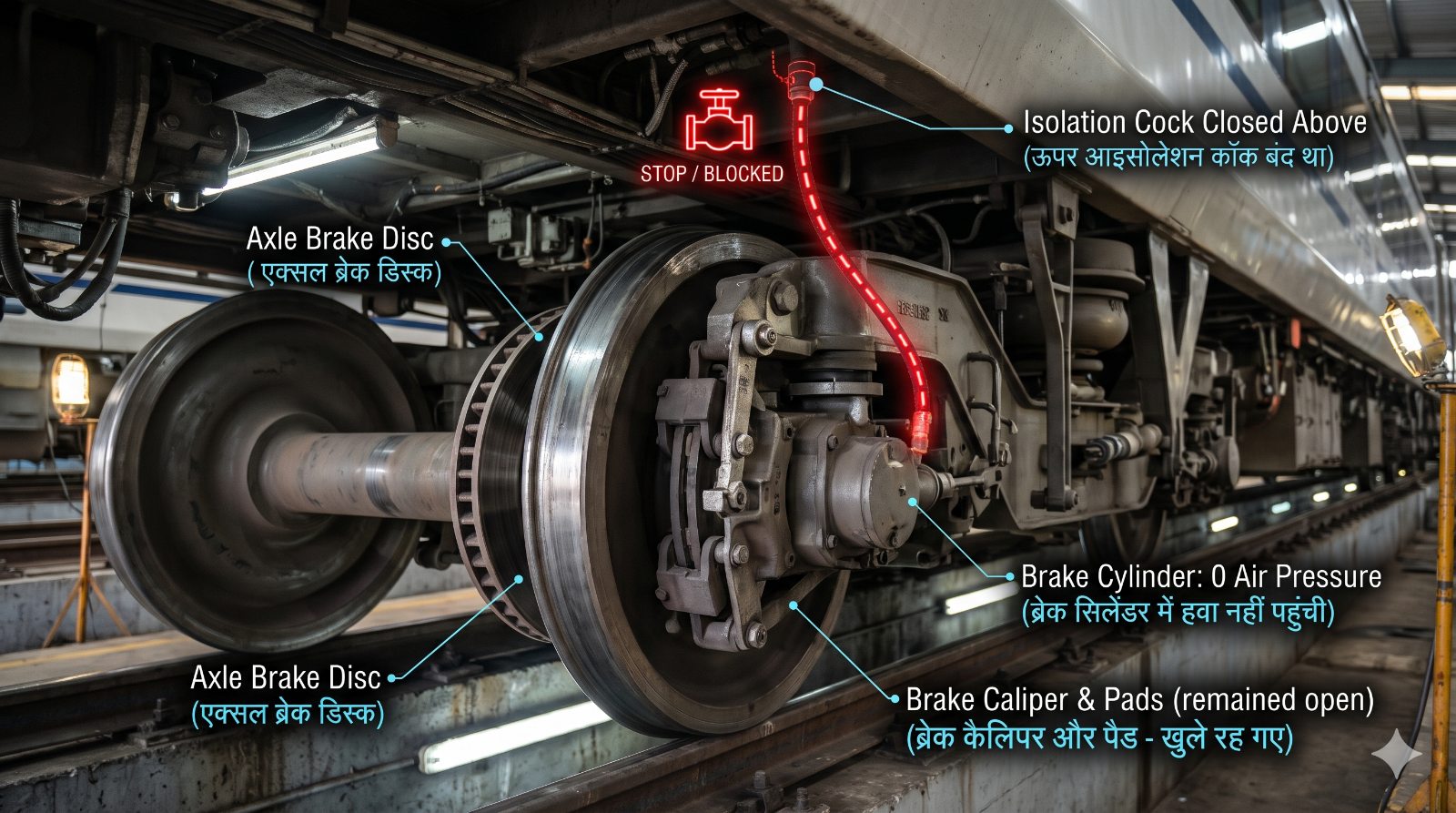
The Exact Mechanical Mistake: Parking Brake Cock vs Bogie Isolation Cock
Every Vande Bharat coach is fitted with spring-applied parking brakes. When the trainset is completely dead and air pressure drops to zero, strong mechanical springs automatically lock the brake pads onto the wheel discs so the train cannot roll away on a gradient.
Before a dead Vande Bharat rake can be pulled by an external locomotive, maintenance staff must go beneath each coach to the B01 pneumatic brake panel, close the Parking Brake Isolation Cock, and manually pull the release cable so the wheels can rotate freely. At the same time, the main Bogie Brake Isolation Cocks must remain open so that air pressure from the locomotive can apply the service brakes during the journey.During the preparation of the rake at Hatia, the main Bogie Brake Isolation Cocks on all coaches were left in the closed position, isolating the entire braking circuit.
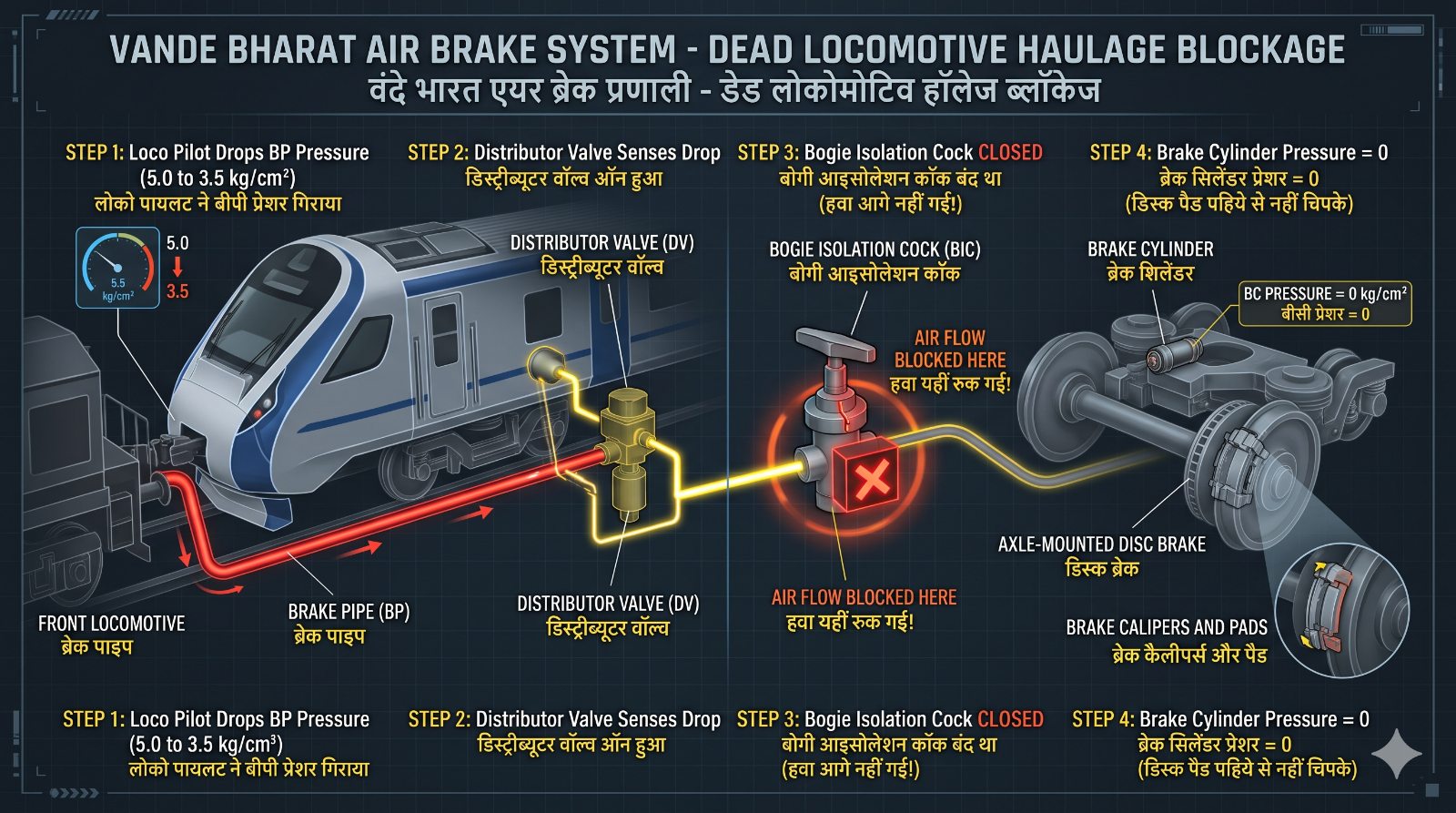
Why Dropping Brake Pipe Pressure Failed to Stop the Coaches
When the second loco pilot at Muri reported that dropping the Brake Pipe pressure had no effect on the coaches, the pneumatic physics behind his observation was straightforward. In an automatic air brake system, when the loco pilot drops the Brake Pipe pressure from 5.0 kg/cm² to around 3.5 kg/cm², the Distributor Valve under each coach senses this pressure drop and sends compressed air into the Brake Cylinders to press the brake pads against the axle discs.
In this incident, when the loco pilot dropped the Brake Pipe pressure from the locomotive cab, the pressure did drop along the main pipe, and the Distributor Valves responded. However, because the Bogie Isolation Cocks situated between the valve and the bogies were physically closed, compressed air could not enter the Brake Cylinders. With Brake Cylinder pressure stuck at zero across every coach, the brake calipers remained wide open throughout the 463-kilometre journey.
The Law of Inertia: How the Loco Pilots Prevented a High-Speed Derailment
From a railway physics standpoint, pulling an unbraked 16-coach Vande Bharat rake weighing over 400 tonnes with a single locomotive is extraordinarily dangerous because of Newton's Law of Inertia.
If the train had been running at high speed and the loco pilot had applied sudden heavy brakes on the front locomotive, the locomotive's wheels would have locked up while the unbraked 400-tonne Vande Bharat rake behind it would have continued surging forward at high speed due to inertia. This massive forward push would have exerted extreme buffing force on the transition coupler and the rear of the locomotive, causing the locked locomotive wheels to skid violently along the rails and potentially derailing the locomotive on a curve or turnout.
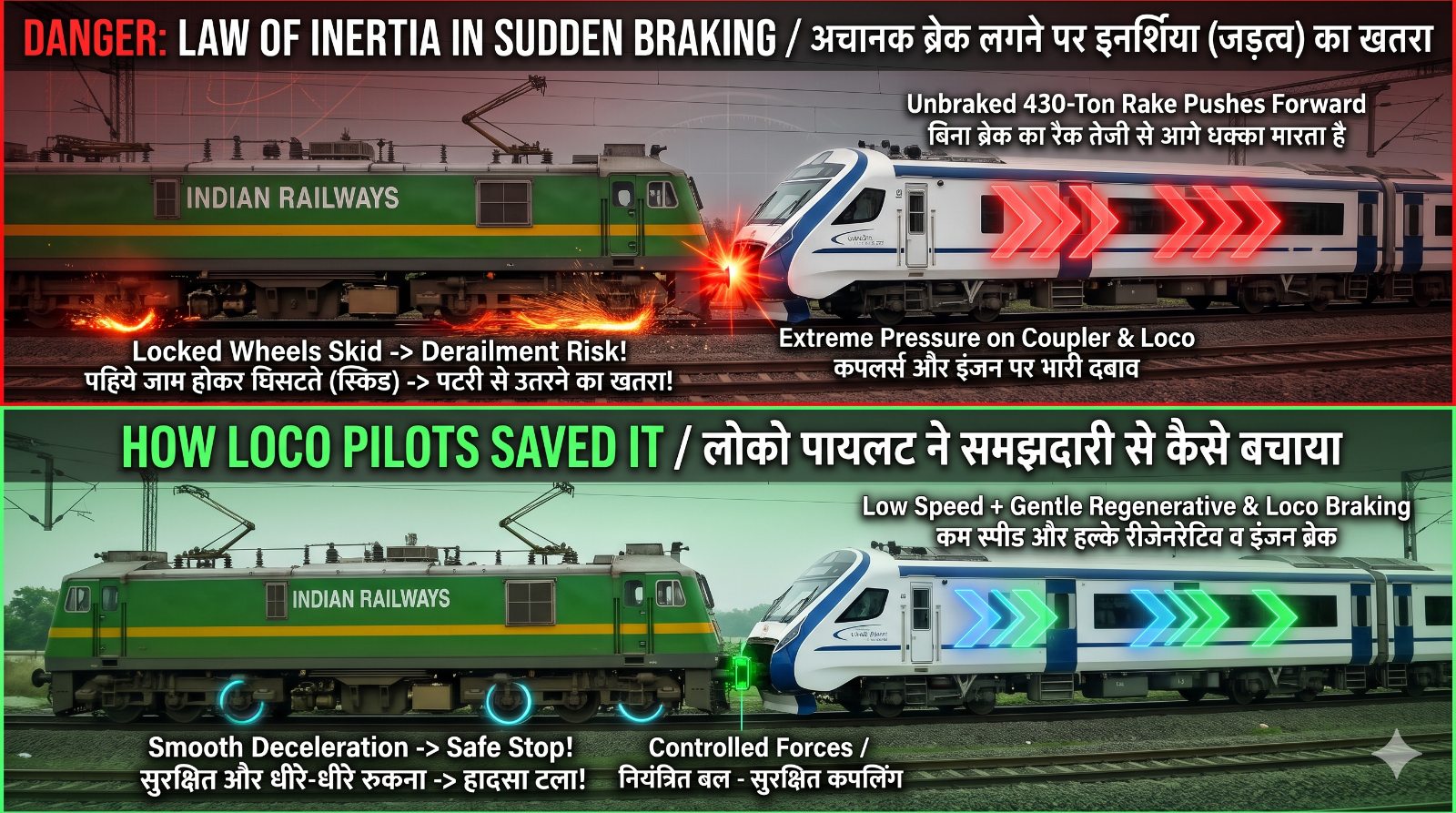
The only reason a major accident was averted over those 463 kilometres was the alertness and driving skill of the loco pilots. Because the first loco pilot detected the lack of coach brake power right in the Hatia–Ranchi section, the crew kept the train at a controlled, low speed and relied on smooth, gradual regenerative braking from the freight locomotive's traction motors along with light independent locomotive brakes well in advance of signals and stations.
South Eastern Railway's Inquiry Order and Key Takeaways
Taking serious note of the incident, South Eastern Railway issued an official order on November 7, 2026, directing the Divisional Railway Manager of Ranchi to conduct a thorough investigation and fix responsibility. The preliminary findings highlighted lapses across three levels: Carriage and Wagon maintenance staff at Hatia failed to physically verify whether the coach brakes were applying before departure; Section and Traction Loco Controllers failed to halt the train despite written and verbal warnings from two loco pilots; and the train crew, being unfamiliar with Vande Bharat's specific underframe braking layout, did not physically inspect the coach brake calipers en route.
Coming just days before the November 11 derailment of the Kolkata–Sairang Express at Digaru station in Assam, where preliminary findings also pointed to an isolated Brake Pipe angle cock, this episode is a strong reminder that world-class rolling stock requires equally strict ground-level maintenance checks and immediate control room action whenever a loco pilot raises a safety red flag.
Watch my full video analysis here -