50 km Bullet Train Stretch Powered Up: Surat–Bilimora 2x25 kV Live Ahead of B28 Trials
Why Surat–Bilimora Is Called the Priority Section:
Out of the entire 508 km Mumbai–Ahmedabad corridor, the 50 km stretch between Surat and Bilimora was chosen as the first priority section to kick off high-speed testing. Construction in Gujarat progressed significantly faster after early land acquisition hurdles in Maharashtra, allowing engineers to complete viaducts, track beds, and OHE mast installation here first. This section features bridges across four rivers, a major steel bridge over National Highway 53 (NH-53), and roughly 94,000 noise barriers along the elevated deck to cut down sound for nearby towns. Crucially, the corridor's very first Traction Substation (TSS) was completed at Bilimora in Navsari district, making it possible to switch on power on this stretch ahead of the rest of the route.
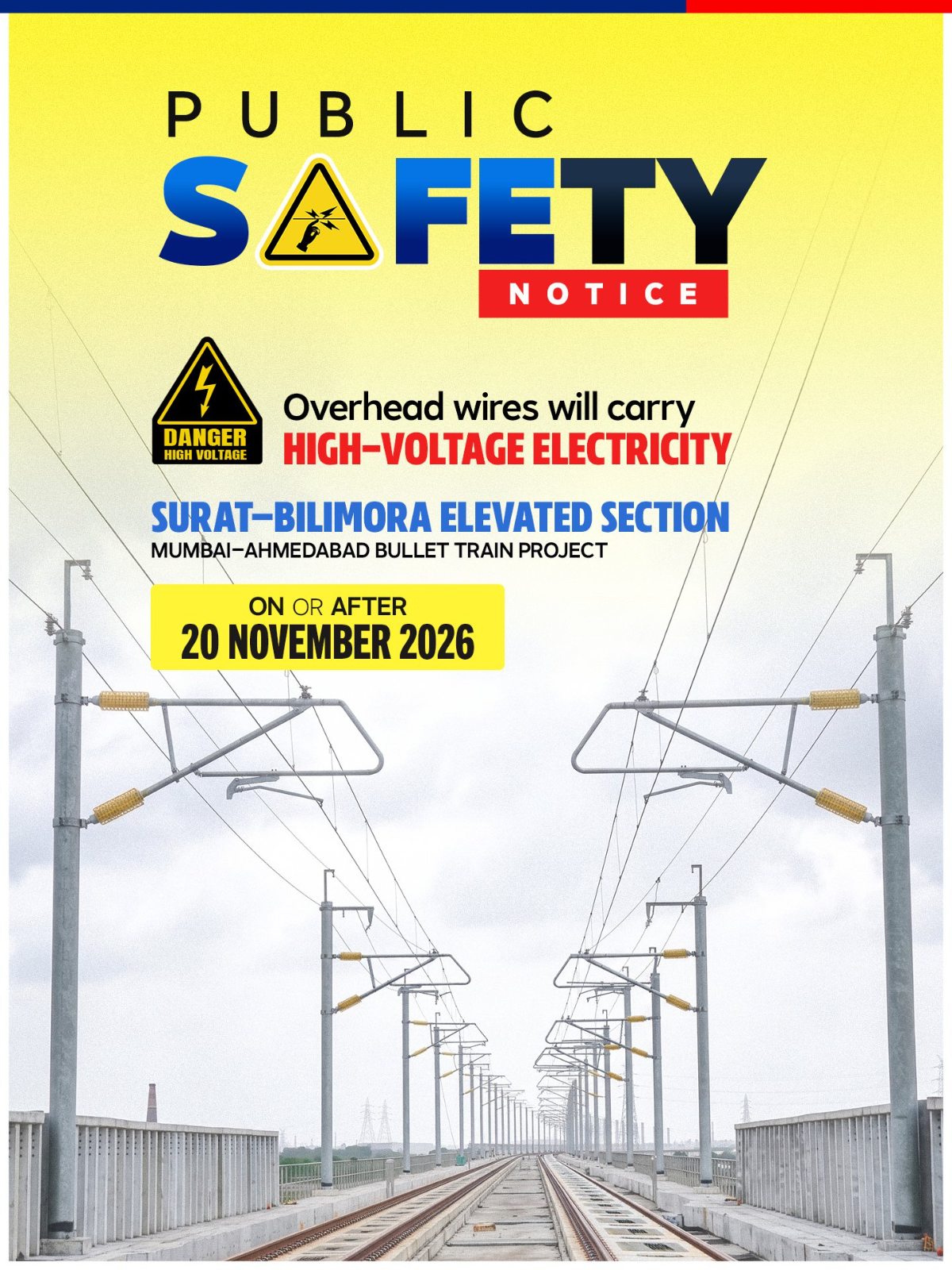
How the 2x25 kV Overhead Traction System Works:
Regular Indian Railways routes mostly use a conventional 1x25 kV electrification setup, where power travels through the overhead wire at 25 kV and returns through the steel rails. That works fine for 130–160 km/h trains, but bullet trains running at 250–320 km/h draw massive electrical power. On a standard 1x25 kV line, high current over long distances causes heavy voltage drops and wasted energy.
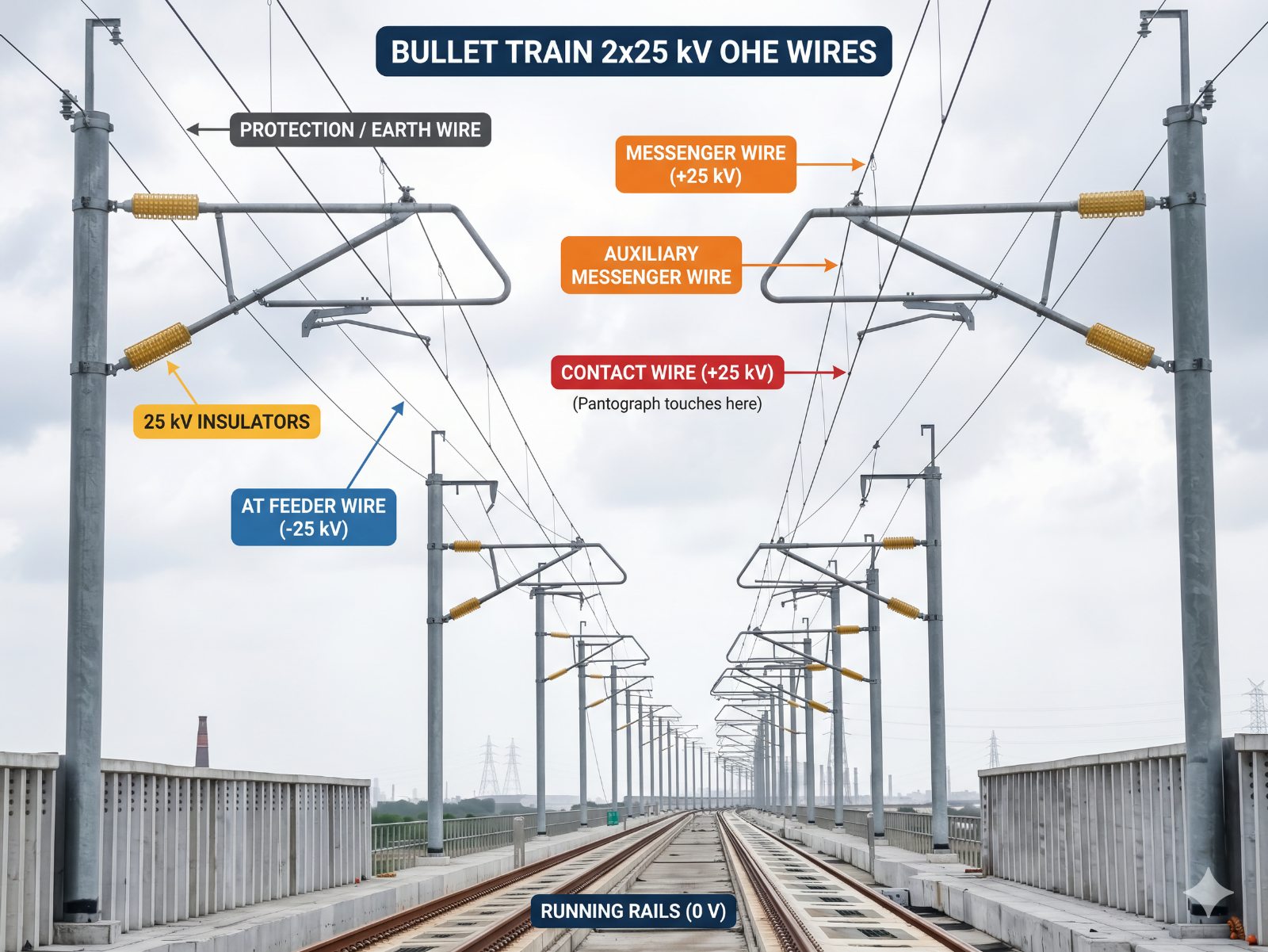
To solve this, the Mumbai–Ahmedabad bullet train corridor uses an advanced 2x25 kV Autotransformer (AT) traction system—the first of its kind on an Indian high-speed rail line. Across the 508 km route, 14 Traction Substations will pull high-voltage power from the grid; in Gujarat, the Bilimora TSS draws power from GETCO's 220 kV Ambetha Grid Substation. Inside the substation, a special centre-tapped transformer sends +25 kV through the overhead catenary wire and -25 kV (opposite phase) through a separate feeder wire, while the rails sit at 0 V in the middle.
In simple terms, electricity travels from the substation at 50 kV (the difference between +25 kV and -25 kV), while the train's roof pantograph still safely collects standard 25 kV, 50 Hz single-phase AC power from the contact wire. Doubling the transmission voltage cuts the long-distance current in half and slashes transmission energy losses to roughly a quarter. It also reduces electromagnetic interference with nearby signalling cables and lets substations be placed further apart. The entire electrical network is watched in real time through a centralised control centre to spot faults immediately and keep high-speed operations stable.
Surat–Vapi Construction Wrapping Up by December 2026:
While Surat–Bilimora is the first 50 km testbed to go live, NHSRCL is not stopping there for the first passenger launch. Because Gujarat construction has maintained strong momentum, the inaugural commercial stretch has been expanded to cover the roughly 97–100 km Surat–Vapi section. All major civil works and river bridges between Surat and Vapi are already complete, with full construction on the Surat–Vapi stretch targeted to finish by December 2026. Commercial services on this expanded Surat–Vapi section are targeted to begin in 2027, while the complete 508 km Mumbai–Ahmedabad corridor is targeted for completion by December 2029.
Indigenous B28 Bullet Train Getting Ready for Trials Here:
With live 2x25 kV power now flowing overhead, the spotlight shifts to rolling stock. India's first indigenous high-speed trainset—the B28—is being jointly developed by the Integral Coach Factory (ICF) and BEML at BEML's Aditya Plant in Bengaluru, and it is slated to hit this newly energised Gujarat stretch for track trials by mid-2027 (around April to June 2027).
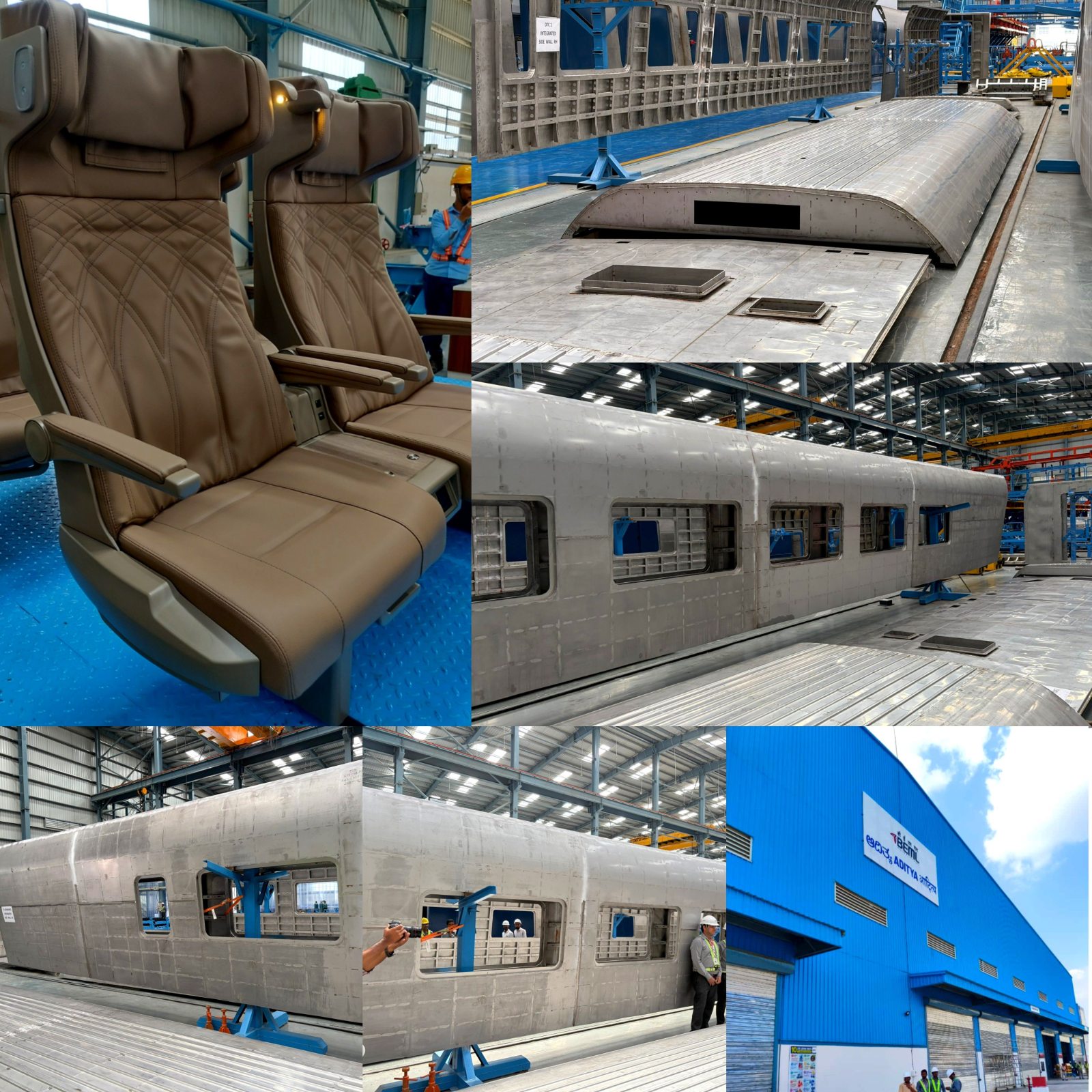
The B28 is engineered for a maximum test speed of 280 km/h and an operational speed of 249 km/h, serving as India's homegrown stepping stone before the corridor's 320 km/h Shinkansen operations and a future 350 km/h indigenous B35 trainset. Each B28 trainset is about 202 metres long with 8 coaches (4 motor cars and 4 trailer cars) and can be coupled into a 16-coach formation. It seats roughly 557 passengers across seven Standard Class coaches (3x2 layout) and one Executive Class coach (2x2 layout). Built with an aerodynamic nose shaped through Computational Fluid Dynamics (CFD) and equipped with regenerative braking, the first B28 carbody frame is already undergoing structural squeeze tests while its bogies, propulsion, and pantograph-to-OHE integration designs are ready. Once B28 arrives in Gujarat next year, this live Surat–Bilimora corridor will host India's first true high-speed rail trials.