Beyond Delhi-Meerut: How NCRTC’s 2,900-Km ‘Namo Bharat’ Masterplan Could Redraw India’s Urban Map
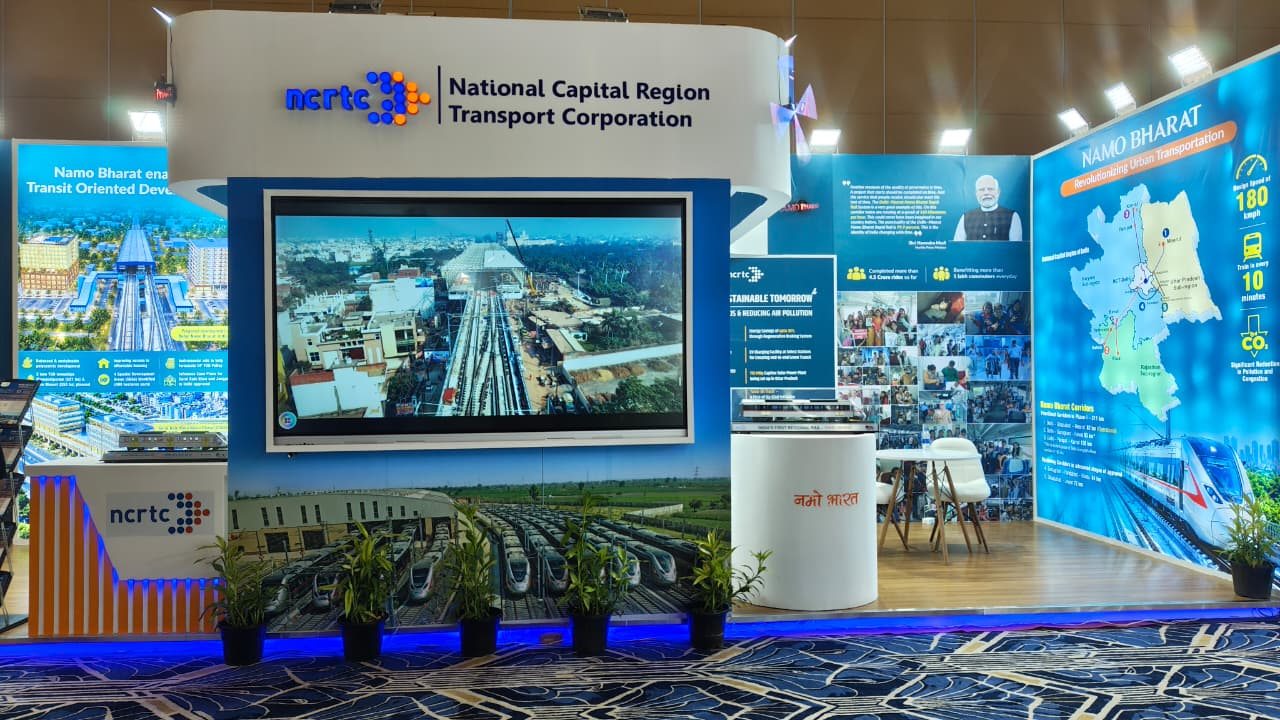
At the 19th Urban Mobility India (UMI) Conference 2026 in Bhubaneswar, Union Minister of State Shri Tokhan Sahu inaugurated the NCRTC pavilion, where the spotlight moved quickly from Namo Bharat’s existing operational success to its massive national potential. Having already carried over 4.5 crore passengers on the 82-km Delhi-Ghaziabad-Meerut corridor with daily ridership crossing one lakh, the Regional Rapid Transit System (RRTS) model has proven its viability. Now, backed by the Economic Survey 2025–26, nearly 2,900 km of potential Namo Bharat corridors have been identified across India’s major regional clusters.
From an NCR Experiment to a National Blueprint: When Union Minister of State for Housing and Urban Affairs Shri Tokhan Sahu inaugurated the National Capital Region Transport Corporation (NCRTC) stall at the 19th Urban Mobility India (UMI) Conference and Expo 2026 in Bhubaneswar (October 23-24), the event was about much more than a routine exhibition. Welcomed by NCRTC Managing Director Shri Shalabh Goel, Odisha’s Housing & Urban Development Minister Dr. Krushna Chandra Mahapatra, and MoHUA Secretary Shri Satendra Singh, the delegation witnessed a model that is ready to scale across India.
The biggest takeaway from the showcase is that Namo Bharat is no longer viewed purely as an NCR project. With 2,900 km of potential RRTS corridors identified across various regional clusters in the country, state governments are actively looking to replicate this semi-high-speed rail network. The Economic Survey 2025-26 explicitly backs this expansion, pointing out that high-speed regional connectivity is essential to turning large regional clusters into self-sustaining hubs of economic growth.
◆ Decoding the 2,900-Km Vision: Why India Needs RRTS:
For decades, Indian rail transit had a missing link. Traditional Metro systems are great for short, intra-city hops (within 10-25 km) with frequent stops, while Indian Railways handles long-distance intercity travel. However, commuters traveling between 50 km and 150 km from a satellite town to a major metro city for daily work were stuck in grueling road traffic or overcrowded conventional trains.
Namo Bharat (RRTS) fills this exact gap:Speed Meets Frequency: With a design speed of 180 km/h and an operational speed of 160 km/h, Namo Bharat is three times faster than a regular metro, features fewer stops, and runs at high commuter-friendly frequencies.
Expanding Across NCR and Beyond: In the NCR alone, Phase-1 originally envisioned three priority corridors-Delhi-Ghaziabad-Meerut (82 km), Delhi-Gurugram-SNB (Shahjahanpur-Neemrana-Behror), and Delhi-Panipat out of eight planned regional corridors.
New Regional Clusters: The 2,900-km identification looks at high-density economic corridors across India where big cities are surrounded by fast-growing tier-2 and tier-3 towns (such as clusters around Mumbai-Pune-Nashik, Bengaluru-Mysuru-Tumakuru, Hyderabad, Chennai, and Kolkata). Connecting these clusters with 160 km/h trains turns separate cities into a single, connected economic zone.
◆ What It Means for the Common Man: Time, Money, and Quality of Life:
Numbers like 2,900 km sound impressive on paper, but the real impact of Namo Bharat is felt directly by the daily commuter and middle-class families:
Earn in the Metro, Live in Your Hometown: Skyrocketing rents and real estate prices in megacities like Delhi, Mumbai, or Bengaluru force people into cramped living spaces. When an 80-km journey takes under an hour, a professional can work in central Delhi while living comfortably in a spacious, affordable home in Meerut, Ghaziabad, or Panipat.
Reclaiming Daily Time: Cutting a 3-to-4-hour daily road commute down to under 60 minutes gives a commuter 2 to 3 hours of life back every single day—meaning less fatigue, lower stress, and more family time.
One Track, Two Systems (Seamless Integration): On the 82-km Delhi-Meerut corridor (15 stations), NCRTC achieved a first-in-India engineering feat by running local Meerut Metro trains on the exact same infrastructure as high-speed Namo Bharat trains. For the common passenger, this means stepping off a 160 km/h regional train and switching directly to a local metro without exiting the station system—saving both money and public tax expenditure on separate tracks.
Flight-Like Comfort at Commuter Prices: Since October 2023, over 4.5 crore passengers have used Namo Bharat, with daily ridership crossing 1 lakh. Commuters get cushioned 2x2 seating, overhead luggage racks, charging ports, Wi-Fi, a dedicated women's coach, a Premium Lounge/Coach option, and dedicated spaces for wheelchairs and medical stretchers—making emergency medical transit to big-city hospitals much faster.
◆ Transit-Oriented Development (TOD): Building New Cities Around Stations:
A major highlight at the NCRTC pavilion was Transit-Oriented Development (TOD). Traditionally in India, cities grow haphazardly first, and public transport struggles to reach them later. NCRTC is flipping this script by planning urban townships around the transit network from day one.
At the Bhubaneswar expo, NCRTC showcased upcoming TOD developments around the Duhai and Sarai Kale Khan stations, along with planned TOD Townships in Harnandipuram (Ghaziabad) and New Meerut.
Walk-to-Work Culture: High-density residential apartments, offices, shopping complexes, and schools are planned within walking distance of Namo Bharat stations.
Affordable Housing: By opening up land pockets along the corridor in New Meerut and Harnandipuram, TOD increases the supply of well-connected, affordable housing.
Multi-Modal Hubs: Major hubs like Sarai Kale Khan integrate Namo Bharat with Indian Railways (Hazrat Nizamuddin), Delhi Metro, and ISBT bus terminals, eliminating last-mile headaches.
◆ High-Tech Operations for the Digital Age:
Aligned with UMI 2026’s theme-“Urban Accessibility and Liveability in the Digital Age”-jointly organized by MoHUA and the Government of Odisha, NCRTC demonstrated how digital tools keep this massive network running smoothly. Visitors at the stall experienced Augmented Reality (AR) and Virtual Reality (VR) setups firsthand.
Behind the scenes, NCRTC uses AR, VR, and Digital Twins (BIM) not as gimmicks, but for precision engineering, staff training, and predictive maintenance. This ensures that tracks, signaling (ETCS Level-2 over LTE), and rolling stock are monitored in real time, minimizing breakdowns and delays for daily office-goers.
By proving that high-speed regional rail can draw over a lakh riders a day, share tracks with local metros, and birth new townships along its route, NCRTC has handed India a tested template. As the 2,900-km vision moves from policy papers to the ground, Namo Bharat is poised to change not just how India travels, but where India chooses to live and work.