Kavach Enters EDFC: DFCCIL’s 931 km Freight Safety Plan
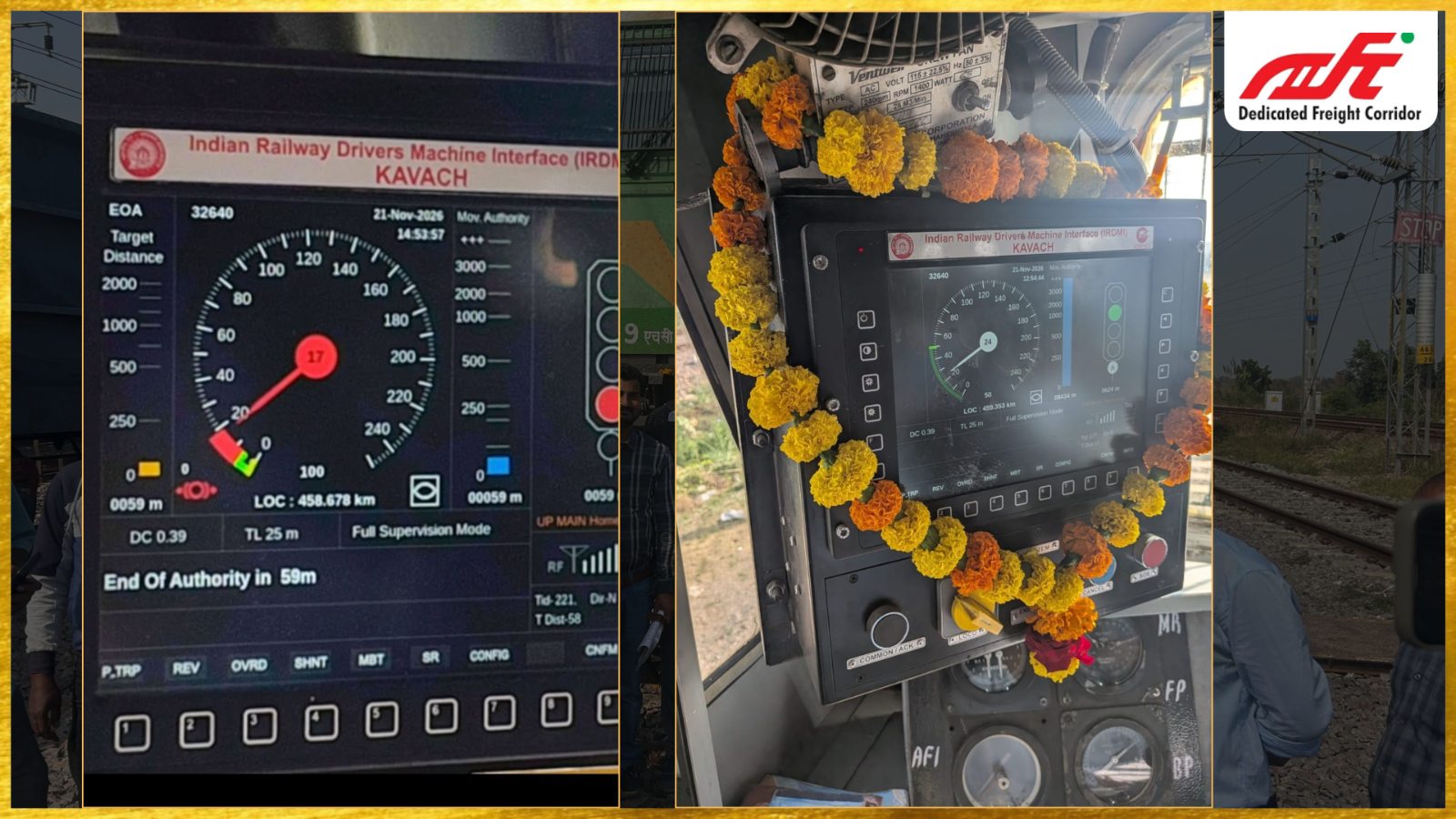
The Dedicated Freight Corridor Corporation of India Limited (DFCCIL) has completed its first-ever Kavach engine trial on the Eastern Dedicated Freight Corridor (EDFC). Conducted by DFCCIL’s Prayagraj Unit on the 40 km New Kanpur–New Malwan stretch, the trial proved that India’s indigenous Automatic Train Protection (ATP) system can safely control heavy-haul freight locomotives on dedicated high-density freight tracks.
▶ What Happened in the 40 km EDFC Kavach Trial?
During the trial run, a Kavach-equipped freight locomotive operated across the New Kanpur–New Malwan section to test live communication between onboard cab equipment, trackside hardware, and EDFC’s automatic signalling system.
DFCCIL validated three core safety functions during the test:
▪ Movement Authority: The onboard system continuously received and followed real-time signal conditions from the trackside signalling network.
▪ RFID Tag Verification: The locomotive accurately read and verified trackside RFID tags installed along the sleepers as per the approved TAG/TIN layout.
▪ Automatic SPAD Prevention: When approaching a red signal ahead, the system automatically applied brakes to stop the train and prevent Signal Passing at Danger (SPAD).
This trial is a technical validation milestone, confirming that trackside RFID tags, station units, and onboard locomotive Kavach hardware work smoothly together on EDFC infrastructure.
▶ Why Does EDFC Need Kavach Urgently?
The 1,337 km Eastern Dedicated Freight Corridor, running from Sahnewal (Ludhiana) in Punjab to Sonnagar in Bihar, is already fully operational and carries heavy coal, steel, and mineral traffic to power plants and industrial hubs.
Traffic density on EDFC has scaled rapidly. According to PRS India’s Railways budget analysis, EDFC handled an average of 198 trains per day in 2024-25 nearly double its original capacity of 100 trains per day. Meanwhile, average freight speeds on DFC tracks currently hover around 37-38 km/h against a target of 60-65 km/h.
Running heavy freight trains at closer headways—especially during dense winter fog across Uttar Pradesh and Bihar—makes automated cab signalling and collision protection essential to safely push train speeds higher.
▶ What Is DFCCIL’s Future Plan After This Trial?
The 40 km New Kanpur–New Malwan test is only the starting point of a much larger corridor-wide safety rollout already under execution:
931 km EDFC Kavach Rollout by 2027: In August 2025, DFCCIL awarded a ₹209.82 crore contract to a Kernex Microsystems-led consortium for the survey, design, supply, installation, testing, and commissioning of Kavach across a 931 km double-line automatic signalling stretch of the EDFC (New Boraki–New Khurja–New Bhaupur–New Unchdih–New Sonnagar). The project carries a 730-day execution window, putting full commissioning on track for around August 2027.
Phased Section-by-Section Commissioning: Following successful engine validation on the New Kanpur–New Malwan stretch, DFCCIL will expand field trials, telecom tower integration, and safety audits section by section across the remaining EDFC blocks before commercial Kavach operations begin.
Seamless Integration with Indian Railways’ Kavach 4.0: Freight locomotives frequently switch between conventional Indian Railways feeder lines and DFC tracks. As of July 31, 2026, Indian Railways has already commissioned RDSO-approved Kavach Version 4.0 on 2,633 route km including 563 route km on the parallel Chipyana-Tundla-Kanpur-Subedarganj trunk line and fitted Kavach on 6,290 locomotives (with work underway on 7,190 more). Equipping EDFC with Kavach ensures uninterrupted end-to-end safety when freight trains cross over at junction stations.
Safety Blueprint for Future Freight Corridors: With the 1,506 km Western Dedicated Freight Corridor (WDFC) completed in March 2026 and the new ~2,150 km East-West Dedicated Freight Corridor (Dankuni–Surat) announced in the Union Budget 2026-27, operational data from EDFC’s Kavach deployment will serve as the technical template for securing India’s expanding heavy-haul rail network.