Kinet Railway Solutions Achieves World's Highest CL1 Welding Certification for Vande Bharat Sleeper: Manufacturing & Electrical Testing Update
Kinet Railway Solutions has passed the stringent audit to earn the EN 15085-2 CL1 (Certification Level 1) certification—the highest global standard for railway welding.
India's upcoming long-distance overnight high-speed rail program has achieved a major quality milestone. Kinet Railway Solutions—the Indo-Russian joint venture manufacturing next-generation Vande Bharat Sleeper trains at the Marathwada Rail Coach Factory in Latur—has successfully passed the rigorous audit for EN 15085-2 CL1 welding certification.
What Is EN 15085-2 CL1 and Why Is It the Highest Railway Welding Standard?
In the global railway industry, EN 15085-2 is the gold-standard European specification governing the fusion welding of railway vehicles. The standard classifies welding facilities from CL1 to CL4 based on the safety consequence of a joint failure, with Certification Level 1 (CL1) sitting at the very top of the pyramid.
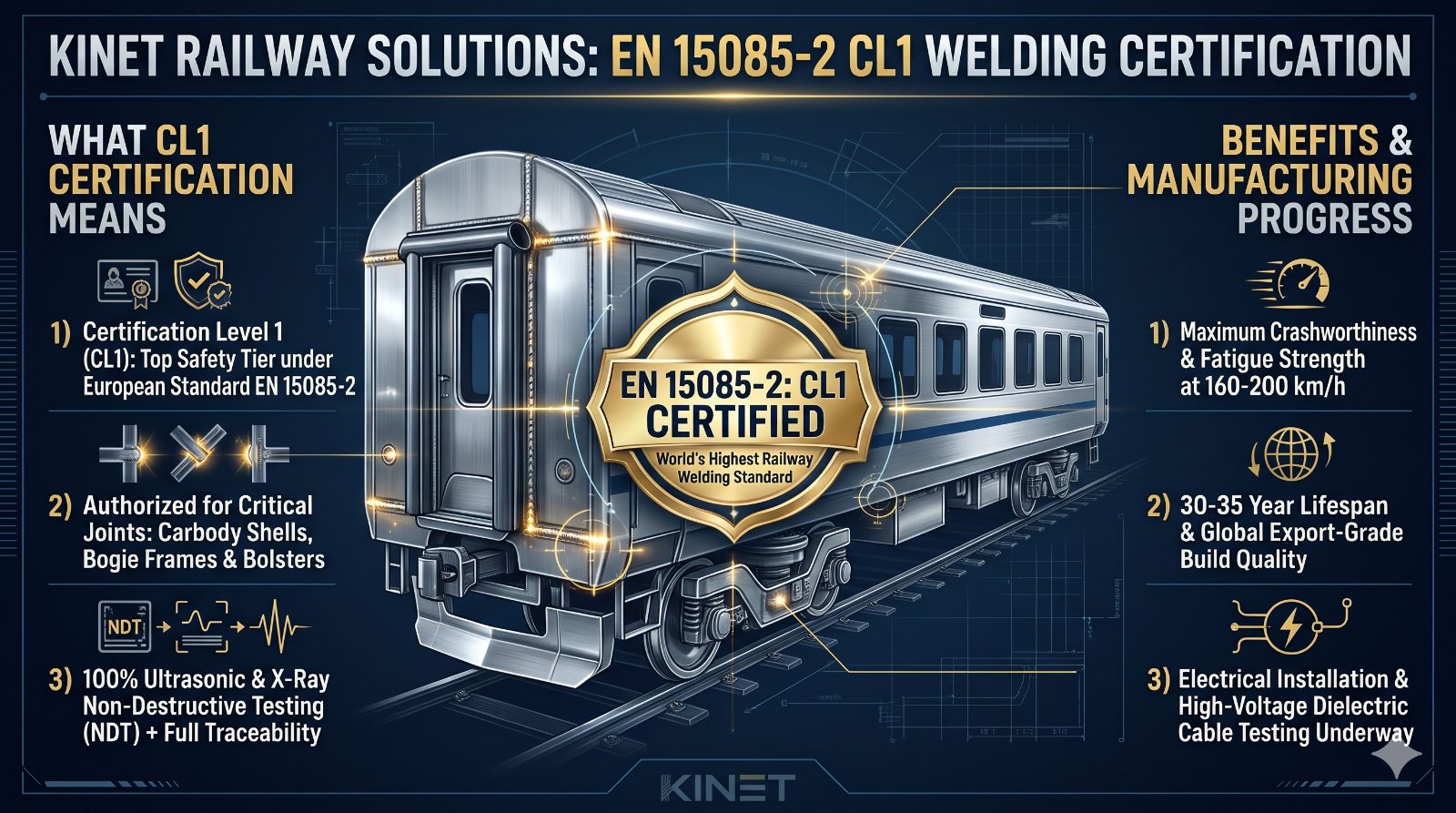
Holding a CL1 certificate means the manufacturing facility meets comprehensive ISO 3834-2 quality requirements and is authorized to weld primary load-bearing, safety-critical structures where any failure could compromise train control or passenger life. Under CL1 guidelines, every critical weld on the carbody shell, bogie frame, and bolster undergoes 100% Non-Destructive Testing (NDT)—such as Ultrasonic Testing (UT) and Radiographic X-Ray Testing (RT)—along with complete digital traceability linking each joint to the specific welder, consumable heat batch, and thermal record.
Key Benefits of CL1 Welding for Vande Bharat Sleeper Trains
Superior Crashworthiness and Passenger Safety: High-strength, defect-free welds ensure the stainless-steel coach shells maintain structural integrity under extreme emergency or impact loads.
High-Speed Dynamic Fatigue Resistance: Designed for operating speeds of 160–200 km/h, CL1-certified bogie and underframe joints can withstand decades of continuous track vibration and dynamic stress without micro-cracking.
30 to 35-Year Service Life: Zero-tolerance quality control prevents premature metal fatigue and corrosion, reducing long-term maintenance costs for Indian Railways.
Global Export-Grade Quality: Achieving EN 15085-2 CL1 puts the Latur facility on par with top European rolling stock factories, making Indian-built sleeper coaches eligible for international export markets.
Where Does Manufacturing Stand Today? Electrical Installation & Dielectric Testing
Beyond carbody shell welding, prototype manufacturing at Kinet's Latur facility has progressed into the critical electrical installation and subsystem integration stage. Modern high-speed sleeper trains require miles of complex wiring across each 16-car trainset to power traction controls, HVAC units, automatic doors, lighting, and fire-safety sensors.
To guarantee zero electrical faults before energizing the coaches, the engineering team has developed and deployed a specialized dielectric strength testing device. This automated diagnostic equipment subjects the installed electrical cables and harnesses to high-voltage insulation breakdown tests—verifying that every cable meets strict dielectric strength parameters and preventing short circuits, current leakage, or fire hazards during commercial operations.
Watch My Complete Video Breakdown Want to see the inside details of Kinet's Vande Bharat Sleeper manufacturing progress, the dielectric cable testing setup, and how HBL Engineering & Ericsson are upgrading Kavach 4.0 to 5G Standalone (5G SA)? Watch our full video explainer below: