PM Modi Approves Delhi to Guwahati Northern Bullet Train Corridor: Route Map, Kanpur & Ayodhya Entry, Phases and Travel Time
PM Modi approves the Delhi to Guwahati Northern Bullet Train Corridor via Agra, Kanpur, Lucknow, Ayodhya, Varanasi, Patna, and Siliguri. Check full route.
India's high-speed rail ambition has just taken its biggest leap forward. Prime Minister Narendra Modi has officially approved the ambitious Northern Bullet Train Corridor, a mega high-speed rail network that will connect the national capital Delhi all the way to Guwahati in Assam via Uttar Pradesh, Bihar, and West Bengal.
Union Railway Minister Ashwini Vaishnaw announced this landmark approval in Varanasi on October 31, 2026, during the flag-off ceremony of the Varanasi–New Delhi Vande Bharat Sleeper Express. Once completed, this corridor will transform inter-state travel across North, East, and Northeast India, slashing a 30-hour train journey between Delhi and Guwahati to under 8 hours.
Key Highlights at a Glance:
Project Approved: Northern Bullet Train Corridor (Delhi to Guwahati via Siliguri) approved by PM Narendra Modi.
Key Cities Connected: Delhi, Jewar Airport, Agra, Kanpur, Lucknow, Ayodhya, Prayagraj, Varanasi, Patna, Siliguri, and Guwahati.
Big Additions in UP: Industrial hub Kanpur and temple city Ayodhya are officially included in the corridor.
Total Distance: Originally 1,557 km up to Siliguri; now estimated at over 1,900 km after adding the Siliguri–Guwahati extension.
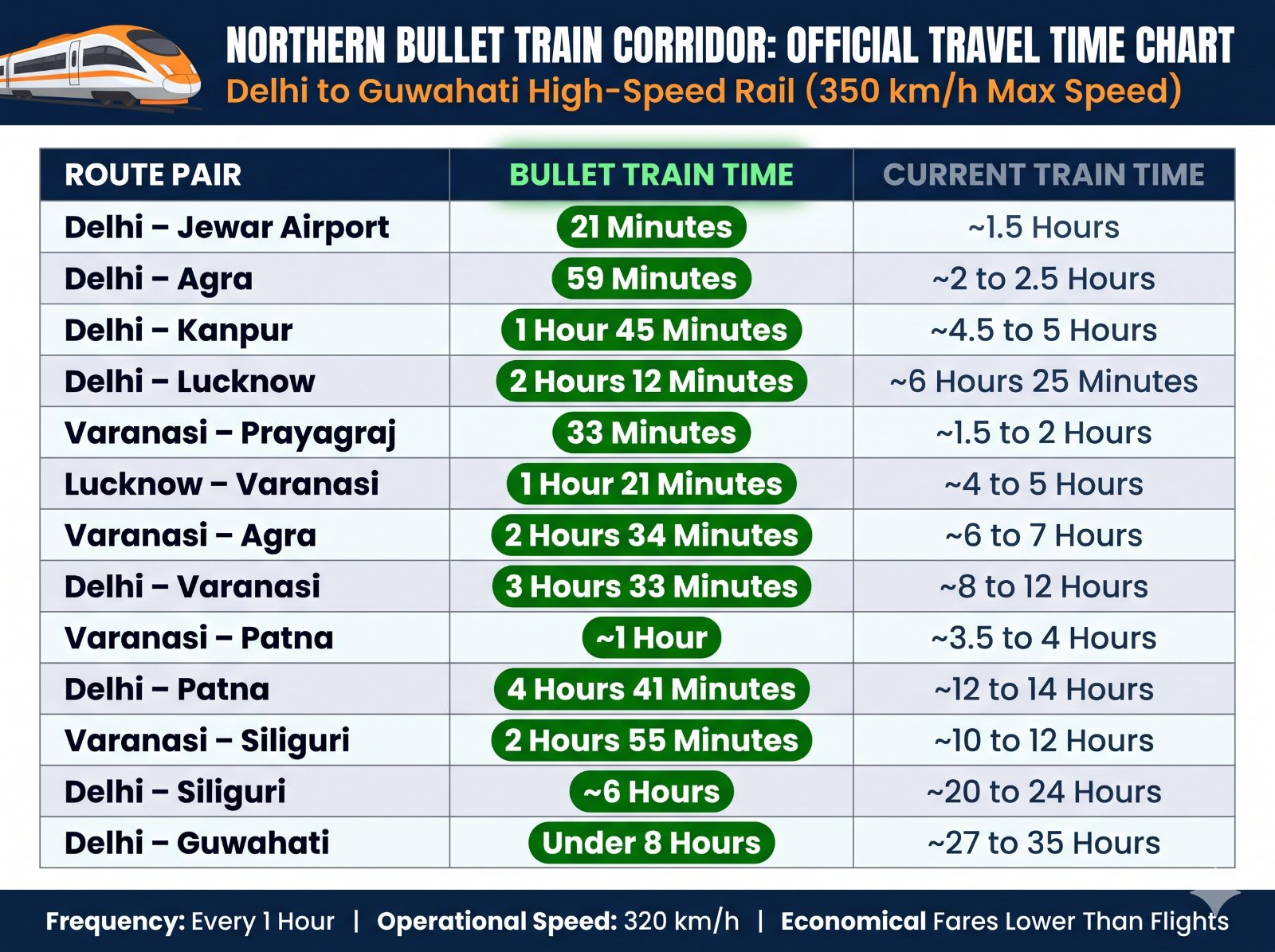
Speed & Frequency: Maximum design speed of 350 km/h (operational speed up to 320 km/h), with bullet trains running every 1 hour at affordable fares lower than flight tickets.
Delhi and Jewar Airport Connectivity: Clearing the Agra Confusion:
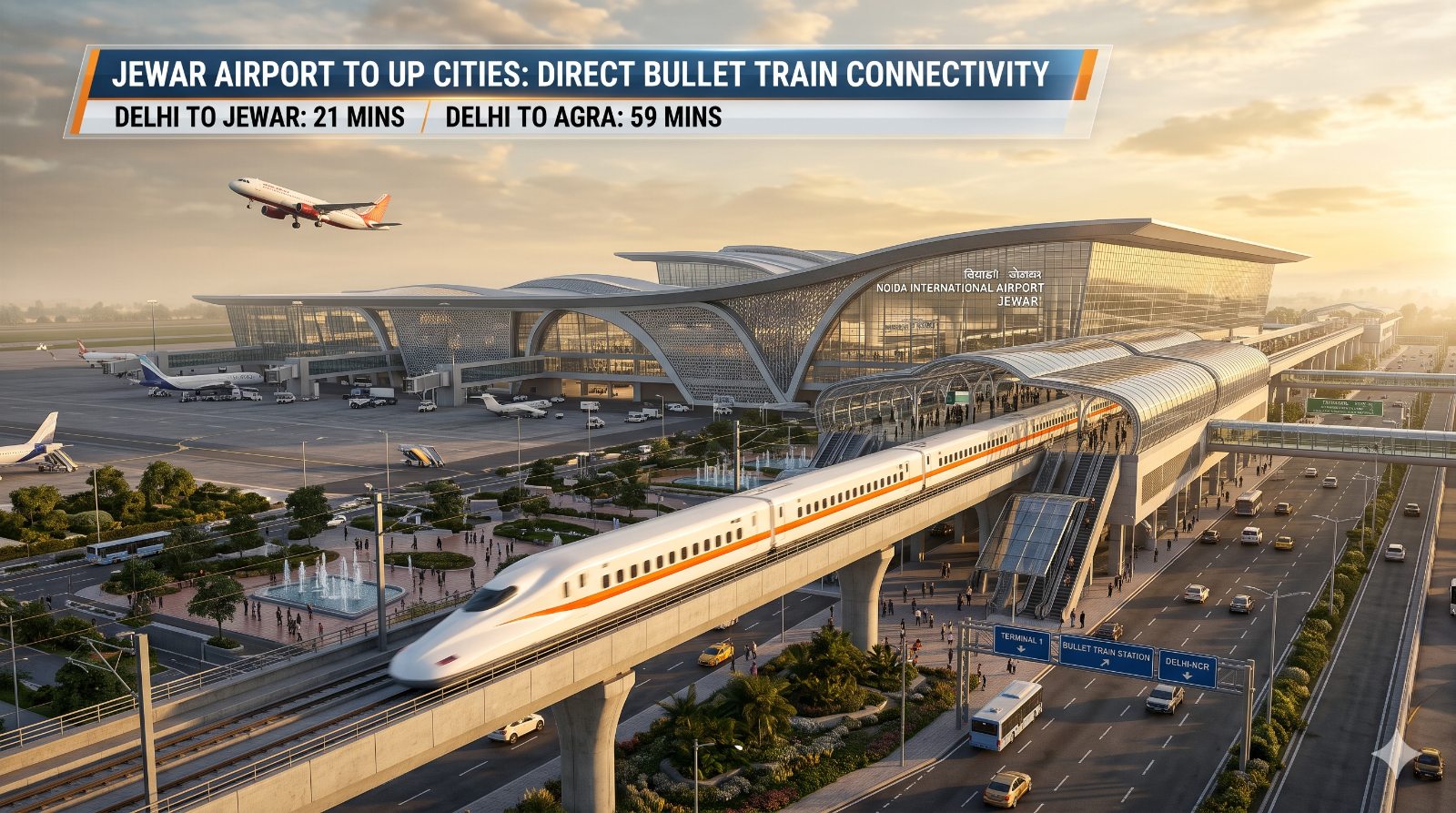
Many early discussions created confusion about whether the corridor begins in Agra. According to official project plans, the corridor starts right from Delhi (Sarai Kale Khan) and connects Noida and the upcoming Noida International Airport at Jewar before heading toward Mathura and Agra.
This direct airport-to-bullet-train integration is a massive upgrade for domestic and international travelers. Passengers landing at Jewar Airport will be able to board a bullet train directly from the terminal and reach Agra, Kanpur, Lucknow, Ayodhya, Prayagraj, or Varanasi rapidly. The journey from Delhi to Jewar Airport will take around 21 minutes, while Delhi to Agra will take just 59 minutes.
Kanpur Officially Added, But What About Kannauj and Etawah?
Back on September 18, 2026, when the final Detailed Project Report (DPR) submission was first discussed, the biggest question was whether Kanpur or Kannauj would make it into the final alignment. Earlier draft alignments along the Agra–Lucknow Expressway had proposed stations at Etawah and South Kannauj while bypassing Kanpur city completely.
Now, Railway Minister Ashwini Vaishnaw has confirmed that Kanpur will have a dedicated Bullet Train station, cutting the Delhi to Kanpur travel time to just 1 hour and 45 minutes. As Uttar Pradesh's largest industrial and commercial hub and home to IIT Kanpur, excluding the city was simply not an option. Following a formal proposal by Kanpur MP Ramesh Awasthi, the Railway Ministry agreed to bring Kanpur onto the main high-speed grid.
However, because the complete revised DPR document and official alignment map have not yet been released in the public domain by the National High Speed Rail Corporation Limited (NHSRCL), one technical question remains open. Earlier technical reports noted that bending the track from Etawah toward Kannauj and then Kanpur would introduce sharp curves, affecting the 350 km/h operating speed. Recent media updates suggest the route may now run directly from Agra toward Kanpur (potentially dropping the earlier Etawah stop or passing near the Araul border in Kannauj/Kanpur Nagar). The exact track path between Agra, Etawah, Auraiya, Kannauj, and Kanpur will become 100% clear only when the Ministry of Railways publishes the final DPR map.
Ayodhya's Historic Entry into the High-Speed Rail Map:
Another major highlight of the approved Northern Corridor is the official inclusion of Ayodhya. In the older project blueprint, the line after Lucknow went straight through Raebareli and Prayagraj to reach Varanasi, leaving Ayodhya out of the primary route.
Given Ayodhya's emergence as one of India's biggest spiritual and cultural tourism centers, the approved corridor now integrates Ayodhya alongside Lucknow, Prayagraj, and Varanasi. With this addition, Mathura, Agra, Ayodhya, Prayagraj, and Kashi will all be linked on a single high-speed rail circuit.
Varanasi to Patna and the Bihar Route:
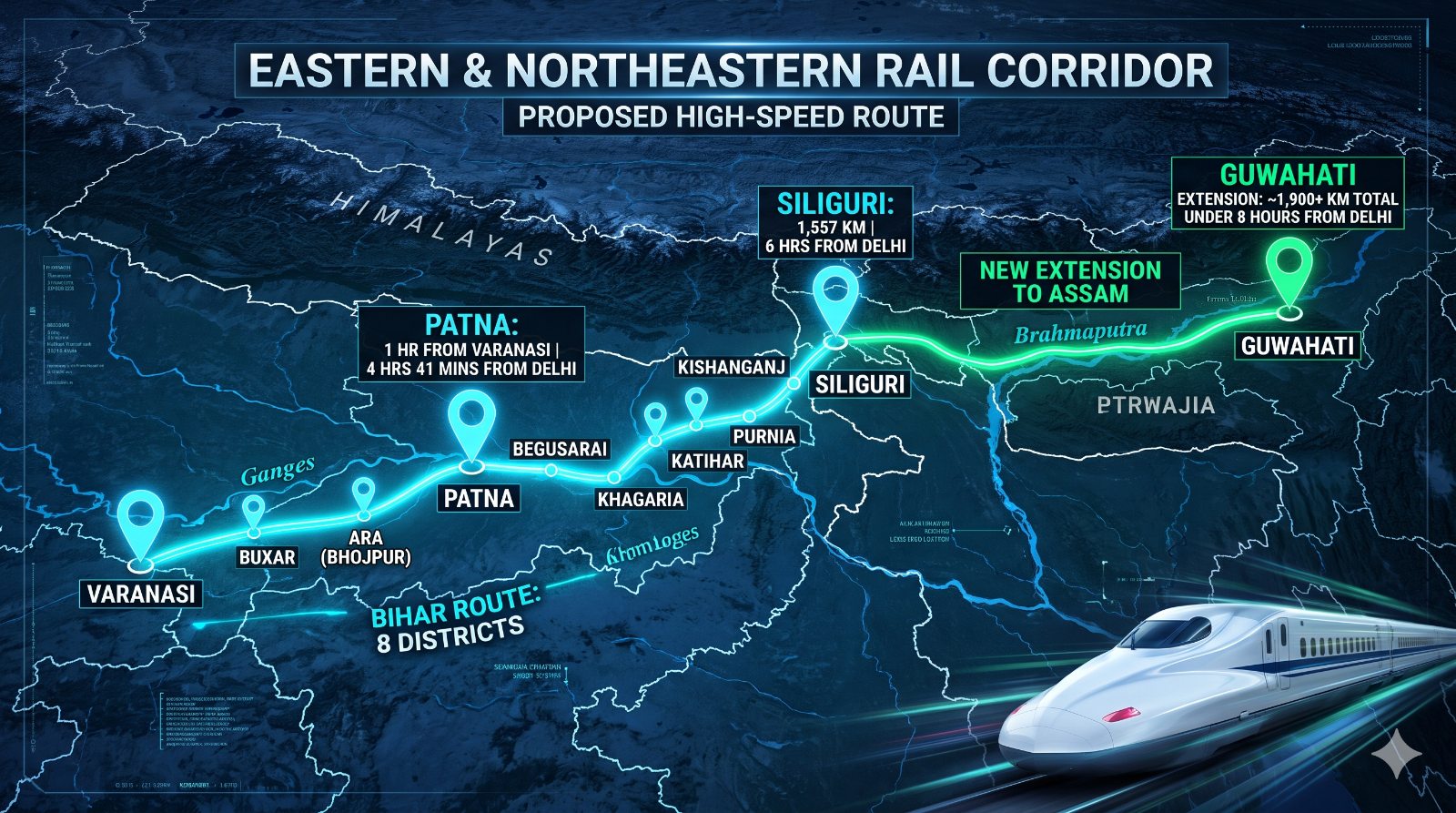
Beyond Varanasi, the corridor enters Bihar and retains its planned alignment toward North Bengal. The bullet train will cover the Varanasi to Patna stretch in just 1 hour, while the journey from Delhi to Patna will drop from 12–14 hours to around 4 hours and 41 minutes.
In Bihar, the corridor will pass through 8 districts: Buxar, Bhojpur (Ara), Patna, Begusarai, Khagaria, Katihar, Purnia, and Kishanganj. Five primary station locations—Buxar, Patna (likely near Phulwari Sharif / AIIMS), Begusarai, Khagaria, and Katihar—are currently under consideration before the line crosses into Siliguri in West Bengal.
The Inside Story of the Siliguri to Guwahati Extension:
Under the Union Budget 2026–27 and the September 2026 DPR submission, the Northern Corridor was divided into two connected sections—Delhi to Varanasi (around 865 km) and Varanasi to Siliguri (around 692 km)—totaling 1,557 km and ending at Siliguri.
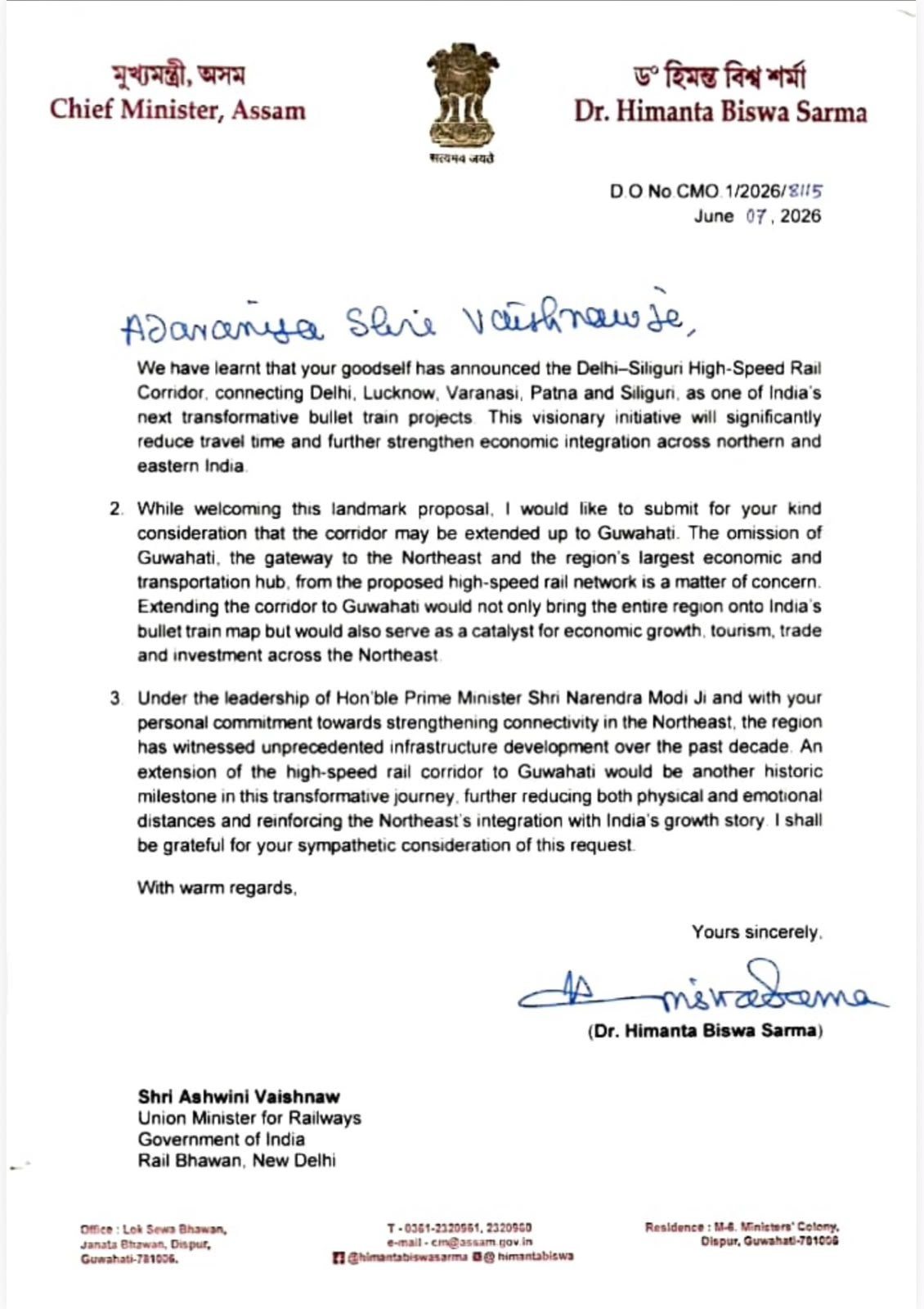
In July 2026, Assam Chief Minister Himanta Biswa Sarma wrote to Railway Minister Ashwini Vaishnaw and met him in New Delhi, requesting that the corridor be extended beyond the Siliguri Corridor into Assam. Recognizing the rapid industrial growth in the Northeast, Prime Minister Narendra Modi approved the extension from Siliguri to Guwahati. Adding this 350 to 400 km stretch pushes the total Delhi–Guwahati mega-corridor length to approximately 1,900+ km (while official briefings continue to reference a 1,500+ km baseline).
Phase-Wise Construction Plan: Which Section Will Be Built First?
The entire Delhi–Guwahati corridor will be developed in three distinct phases:
Phase 1 (First Priority – Delhi to Varanasi, ~865 km): Among the seven new bullet train corridors announced in Union Budget 2026–27, Delhi–Varanasi is at the most advanced stage and holds top priority. Within this phase, civil construction is planned to begin first on the Delhi–Agra priority section, followed by Agra–Kanpur–Lucknow, and then Lucknow–Ayodhya–Prayagraj–Varanasi.
Phase 2 (Varanasi to Siliguri via Patna, ~692–744 km): NHSRCL submitted the DPR for this section to the Railway Ministry in September 2026, moving it into the survey and pre-construction preparation stage.
Phase 3 (Siliguri to Guwahati Extension, ~350–400 km): Newly approved in principle in October 2026, this northeastern extension will undergo detailed alignment surveys and DPR preparation as the third phase of the project.
Official Bullet Train Travel Time Chart:
Watch My Complete Video Analysis on YouTube: