Rishikesh-Karnaprayag Rail Project Ground Report: 83% Work Completed, First Train Timeline, and the Real Story Behind 16 Tunnels & 19 Bridges
The 125.2-kilometer Rishikesh–Karnaprayag broad-gauge rail project in the Garhwal Himalayas of Uttarakhand has entered its final phase of construction, with roughly 80 to 83 percent of overall physical work and 97 percent of tunnel excavation now complete. Once operational, this engineering marvel will slash travel time between Rishikesh and Karnaprayag from a grueling 7 to 8 hours by road to just 2 to 2.5 hours by train. Nearly 83 percent of the entire route (around 104 km) runs underground through 16 main tunnels, linked across deep Himalayan valleys by 19 major bridges—comprising 16 main-line railway bridges and 3 major river-crossing station approach bridges.
Running a broad-gauge train deep into the rugged mountains of Uttarakhand is no longer a distant dream. The 125.2 km Rishikesh–Karnaprayag Rail Project is not just a railway line; it is one of the most complex mountain engineering projects ever undertaken in India. Passing through five districts of Uttarakhand - Dehradun, Tehri Garhwal, Pauri Garhwal, Rudraprayag, and Chamoli this corridor will bring all-weather rail connectivity to the heart of the Garhwal Himalayas for the first time.
What makes this project truly unique is its 'Tunnel–Bridge–Tunnel' design. Throughout the journey, a train will exit a mountain tunnel, cross a high bridge over a river or gorge, and immediately enter the next mountain tunnel. Out of the total 125.2 km alignment, 83 percent (approximately 104 km) lies completely underground.
◆ The 12 Stations and Latest Route Map Progress:
Beyond the existing Virbhadra station, the project features 12 key railway stations along the Ganga and Alaknanda river valleys:
Yog Nagari Rishikesh, Shivpuri , Byasi, Devprayag , Janasu , Maletha , Srinagar (Garhwal) , DhariDevi , Tilani(Rudraprayag) , Gholtir , Gauchar , Karnaprayag (Sevai).
According to the latest project update from the Ministry of Railways, over 101 km of the 104 km across 16 main-line tunnels has already been excavated. Alongside the main track, 12 parallel escape tunnels spanning 98 km are being built for emergency passenger evacuation, of which more than 95 km is complete. Major milestones—including the breakthrough of India's longest rail transportation tunnel, Tunnel-8 (14.5 km) between Devprayag and Janasu—have already been achieved. Today, active excavation is concentrated on the final stretches of just two highly complex tunnels: T1 and T5.
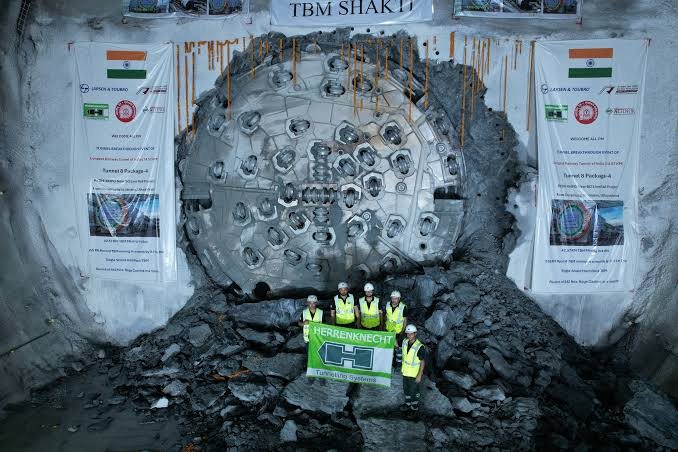
◆ TBM Modifications and the Geological Challenges of Tunnels T1 & T5:
Unlike peninsular India, which has hard granitic rock, the Himalayas are young fold mountains. Excavating here exposes soft soil, fractured rock, and humus (soft strata). Under immense mountain pressure, tunnels dug into soft strata tend to compress inward—a phenomenon known in engineering as 'Squeezing Tendency'.
To overcome this squeezing ground without getting stuck, engineers modeled the Himalayan rock pressure and made three major modifications to the Tunnel Boring Machines (TBMs 'Shiv' and 'Shakti'): the front cutter head was redesigned for mixed and fragile strata, the protective shield and plate assembly behind the cutter was reinforced, and the drive system was upgraded with extra torque and extra thrust so the machine could push forward even under heavy ground pressure.
▶ Why Tunnel-1 (T1 — Rishikesh to Shivpuri, 10.85 km) Is the Toughest:
Starting from Dhalwala right after crossing the Chandrabhaga River (Bridge B01) near Yog Nagari Rishikesh, Tunnel-1 passes beneath the hills of Ghughtiyani Talli and Jamari Katal to reach Shivpuri. This stretch lies in the fragile Main Boundary Thrust (MBT) zone of the Lower Siwaliks, where geological conditions are the most unstable. During excavation, high-pressure underground water gushes out of the rock face, and dense village habitation sits directly above the tunnel. To prevent surface settlement or cracks in houses above, engineers are using micro-piles and chemical grouting to stabilize the mountain step by step. Its parallel 10.847 km Escape Tunnel-1 achieved 100% breakthrough in September 2026, while over 94% of Main Tunnel-1 has been excavated, leaving only the final 500–600 meters in progress alongside parallel concrete lining.
▶ What Makes Tunnel-5 (T5 — Byasi to Devprayag, 9.76 km) So Challenging:
The 15 km stretch between Byasi and Devprayag contains four tunnels (T4, T5, T6, and T7), of which T4, T6, and T7 are already completed. Located beneath the Kaudiyala and Teen Dhara hills, Tunnel-5 runs parallel to the steep Ganga gorge through highly fractured quartzite and phyllite shear zones in Seismic Zone-V. Its exit portal connects directly onto the high Bridge B06 in a narrow gorge with very limited working space, while live traffic on the Rishikesh–Badrinath National Highway (NH-7) runs directly above. More than 70% of T5's excavation is complete, and concrete lining work is progressing rapidly.
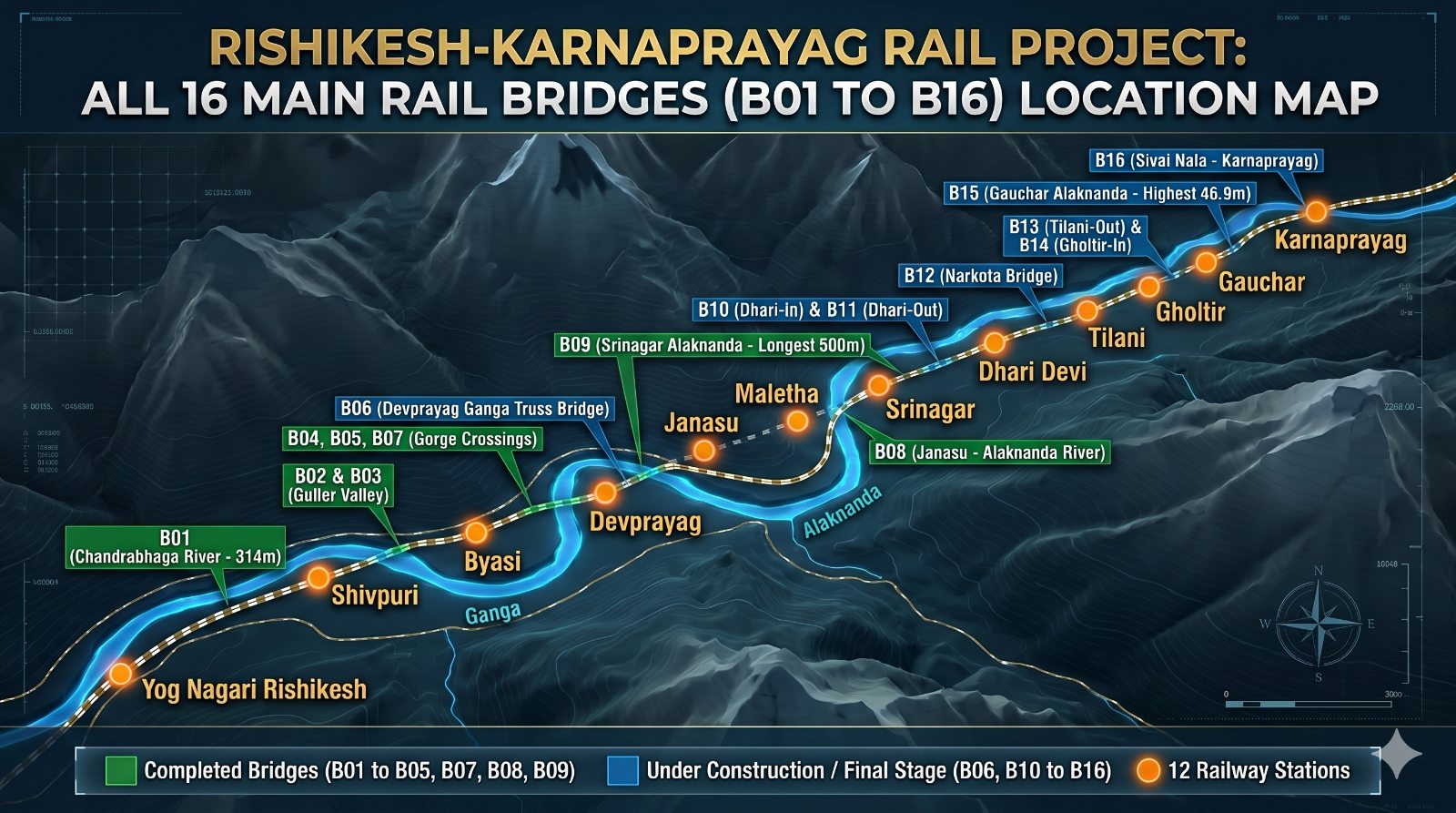
◆ The Real Story Behind 16 vs. 19 Bridges: Where Are They Located?
A common question among viewers looking at the official route map is: if the main railway track only numbers bridges from B01 to B16 (16 bridges), why do project reports state 19 major bridges? And why do presentation maps only display five bridge labels (B01, B06, B08, B09, and B15)?
To keep the map uncluttered, only the 5 most iconic river-crossing rail bridges are labeled on overview graphics. The full count of 19 major bridges follows a simple 16 + 3 = 19 formula:
1. The 16 Main-Line Rail Bridges (B01 to B16):
B01 (Rishikesh): 314.4-meter first rail bridge over the Chandrabhaga River (Completed).
B02 & B03 (Shivpuri–Byasi): Two bridges across the Guller valley between Tunnels T2 and T3 (Completed).
B04, B05 & B07 (Byasi–Devprayag): Three bridges spanning deep mountain gorges between Tunnels T4, T5, T6, and T7 (Completed).
B06 (Devprayag): Massive steel truss bridge across the Ganga gorge immediately after Tunnel T5 (Under Construction).
B08 (Janasu–Maletha): High-pier rail bridge (40-meter piers) across the Alaknanda River (Completed).
B09 (Srinagar): The longest rail bridge (500 meters) of the entire project, crossing the Alaknanda River between Srinagar and Dhari Devi (Completed).
B10 & B11 (Dhari Devi): The Dhari-In and Dhari-Out bridges flanking Dhari Devi station (Final Stage).
B12 (Narkota): Rail bridge across the Narkota gorge between Tunnels T12 and T13 (Under Construction).
B13 & B14 (Tilani–Gholtir): The Tilani-Out and Gholtir-In rail bridges (Under Construction).
B15 (Gauchar): The highest rail bridge (46.9 meters high) of the project, crossing the Alaknanda River near Rano village after Gauchar station (Under Construction).
B16 (Karnaprayag/Sevai): The final main-line rail bridge over Sivai Nala right after Tunnel T16, leading into Karnaprayag station yard (Under Construction).
2. The 3 Major Station Approach Bridges (16 + 3 = 19):
Because key stations in the Alaknanda valley—specifically at Srinagar/Lachmoli, Gauchar, and Karnaprayag (Sevai-Kaleshwar)—are located on the opposite bank of the Alaknanda River from National Highway NH-7, three large river-crossing motor/approach bridges were built across the Alaknanda to connect the highway directly to the railway stations (including the 125-meter Bow-String Arch Bridge at Sevai-Kaleshwar and the 110-meter Open Web Girder Bridge at Gauchar). Since these three bridges carry passengers and vehicles across the river to the stations rather than the main rail track, they are not numbered B17–B19. Out of the 19 major bridges in total, 11 have been completed and the remaining 8 are in advanced stages of construction.
◆ First Train Timeline and Strategic Importance:
Priority Section (June 2028): The first phase between Yog Nagari Rishikesh, Shivpuri, and Byasi is targeted for commissioning by June 2028, marking the first train run into the hills on this corridor.
Full Corridor Completion (December 2029): The complete 125.2 km line from Rishikesh to Karnaprayag is targeted to become fully operational by December 2029.
Char Dham Pilgrimage & China Border Security: Beyond offering a safe, landslide-free journey for millions of pilgrims visiting Kedarnath and Badrinath, the project holds immense strategic value. Its terminal station at Karnaprayag lies just 123 kilometers from the India–China border, providing the armed forces with rapid, all-weather logistics movement toward the frontier.
Watch the Complete 3D Map & Visual Analysis in Our Video 👉